Impeachment by Jon Meacham & Timothy Naftali & Peter Baker & Jeffrey A. Engel
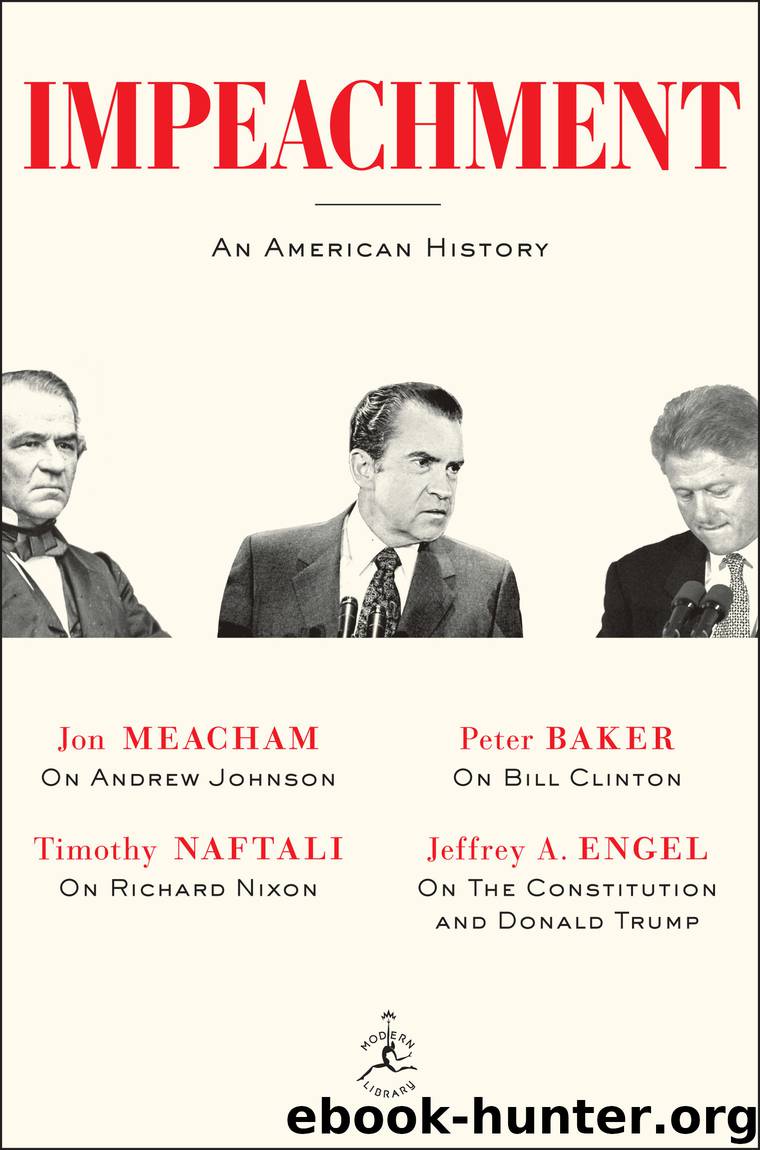
Author:Jon Meacham & Timothy Naftali & Peter Baker & Jeffrey A. Engel
Language: eng
Format: epub
Publisher: Random House Publishing Group
Published: 2018-10-15T16:00:00+00:00
* * *
—
As July began, Doar’s assumption that open-minded elected representatives would accept the removal of a president for a pattern of action that threatened the very institutions that protected their liberty was under severe strain. He was right in believing that if you gave them a mosaic of information they would be able to pull together a story themselves. These were intelligent, hardworking, and responsible individuals. Doar’s mistake was in forgetting that besides being lawyers, they were politicians.
These representatives needed more than the solution to an intellectual puzzle to be able to vote against a man supported by their party or, in the case of the Southern Democrats, by most of their constituents. Not being a politician, Doar did not understand that these individuals had to feel they could advocate impeachment, on their own, in their own words and in a way their supporters could understand. By making them passive recipients of information, Doar had not helped them become advocates.
This process of turning supporters into advocates of impeaching Richard Nixon would take place in July. Decades later Americans would ask themselves whether members of Congress were capable only of bitter partisanship. For four weeks at a pivotal moment in American history in 1974, a handful of elected representatives found that something greater than partisanship could guide them when the fate of the country hung in the balance.
“I wanted to get it ‘right,’ ” remembered Raymond Thornton of Arkansas. “This was most likely the most important task that I would ever have in government.”101 From the beginning, Thornton had concluded impeachment was “a safety valve for our system of government, not merely a punishment for crimes or misbehavior.” On June 4, 1974, he dictated for his personal record that “such charges must not be brought lightly, but on substantial evidence; the actions complained of threaten the continued existence of our country as a constitutional government under which all men are held equally accountable under the law.” Thornton believed that he had to forget about the fact that he was an elected official. “This decision is too vital and too important to be based upon partisan politics or newspaper headlines.”102
Remarkably, six other members of Congress came to a similar understanding around the same time. For months they had been connecting the dots—Doar’s dots—on their own. It was noteworthy that they accepted the information pulled together by the impeachment staff as their baseline of facts. There was no alternative timeline or fake news conspiracy to distract them from deciding if this pattern of conduct warranted removal of a president from office. However inconvenient they might be, facts were facts. Not one of them doubted that the Nixon White House had become a criminal enterprise. The question was whether a fairly elected president should lose his job, if his direct responsibility could arguably only be inferred.
The month of July brought the moment of decision for these undecided representatives because Rodino had scheduled publicly televised hearings and a vote for the last week of the month.
Download
This site does not store any files on its server. We only index and link to content provided by other sites. Please contact the content providers to delete copyright contents if any and email us, we'll remove relevant links or contents immediately.
| Africa | Americas |
| Arctic & Antarctica | Asia |
| Australia & Oceania | Europe |
| Middle East | Russia |
| United States | World |
| Ancient Civilizations | Military |
| Historical Study & Educational Resources |
Cat's cradle by Kurt Vonnegut(15355)
Pimp by Iceberg Slim(14507)
4 3 2 1: A Novel by Paul Auster(12392)
Underground: A Human History of the Worlds Beneath Our Feet by Will Hunt(12098)
The Radium Girls by Kate Moore(12028)
Wiseguy by Nicholas Pileggi(5786)
The Fire Next Time by James Baldwin(5446)
Perfect Rhythm by Jae(5403)
American History Stories, Volume III (Yesterday's Classics) by Pratt Mara L(5308)
Paper Towns by Green John(5191)
Pale Blue Dot by Carl Sagan(5008)
A Higher Loyalty: Truth, Lies, and Leadership by James Comey(4964)
The Mayflower and the Pilgrims' New World by Nathaniel Philbrick(4503)
The Doomsday Machine by Daniel Ellsberg(4490)
Killers of the Flower Moon: The Osage Murders and the Birth of the FBI by David Grann(4447)
The Sympathizer by Viet Thanh Nguyen(4390)
Too Much and Not the Mood by Durga Chew-Bose(4348)
The Borden Murders by Sarah Miller(4325)
Sticky Fingers by Joe Hagan(4199)
